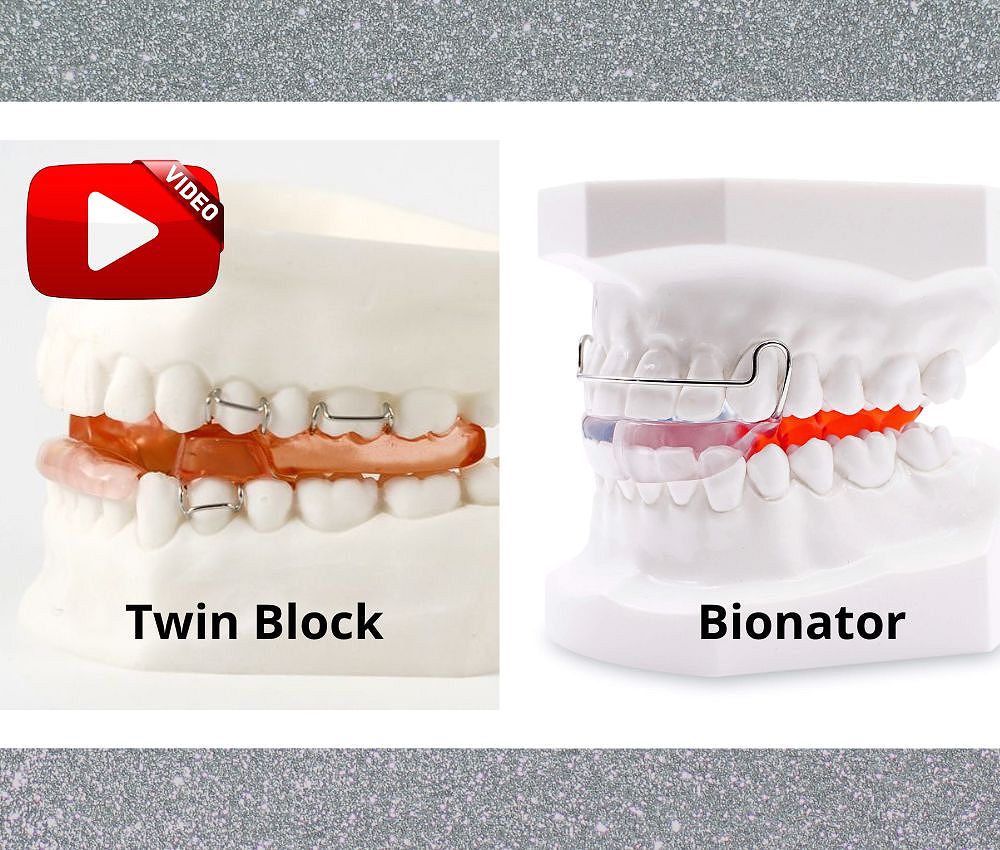
The Twin Block technique is a removable functional orthodontic approach primarily used to manage Class II malocclusion associated with mandibular retrusion in growing patients.
📌 Recommended Article :
Video 🔽 Bionator Appliance: Objectives, Indications, Advantages and Disadvantages ... The Bionator appliance is introduced as a key functional device in early orthopedic treatment, guiding jaw growth and improving the balance between oral structures during a child’s developmental years.Developed by William J. Clark, the appliance consists of separate maxillary and mandibular components incorporating inclined bite blocks that posture the mandible forward.
Advertisement
Its clinical objective is not simply to reposition the mandible temporarily, but to use mandibular advancement during growth to promote favorable skeletal, dentoalveolar, and soft-tissue adaptations.
Contemporary evidence indicates that Twin Block therapy can effectively reduce overjet and improve the sagittal relationship, although the magnitude of true skeletal modification is generally more modest than the term “growth modification” may imply.
📌 Recommended Article :
Dental Article 🔽 Herbst Appliance vs Twin Block: Key Differences ... Herbst Appliance and Twin Block are two of the most commonly used functional orthodontic appliances for treating Class II malocclusion caused by mandibular retrusion.🔹 What Is the Twin Block Technique?
The Twin Block appliance consists of upper and lower removable plates with acrylic bite blocks positioned at specific sagittal inclinations. When the patient closes, the blocks guide the mandible into a more advanced position.
This mandibular advancement produces a combination of:
▪️ Skeletal adaptation, particularly mandibular positional and growth-related changes.
▪️ Dentoalveolar compensation, including changes in incisor inclination and molar relationships.
▪️ Soft-tissue improvement, particularly in patients with mandibular retrusion and increased overjet.
Importantly, the final correction results from the interaction between these mechanisms rather than from mandibular growth alone. Systematic reviews have consistently identified a combined skeletal and dentoalveolar contribution to Class II correction.
📌 Recommended Article :
Dental Article 🔽 Most Used Interceptive Orthodontic Appliances: Indications and Uses ... This article reviews the most commonly used interceptive orthodontic appliances, their indications, and clinical objectives, supported by current scientific evidence.🔹 Indications for Twin Block Therapy
The technique is most appropriate when the patient presents with:
▪️ Skeletal Class II malocclusion primarily related to mandibular retrusion
▪️ Increased overjet
▪️ Favorable remaining mandibular growth potential
▪️ Acceptable vertical proportions
▪️ Sufficient patient cooperation for a removable appliance
▪️ A sagittal discrepancy that can be improved through mandibular advancement
The growth stage is more clinically relevant than chronological age alone. Treatment is generally most effective when significant mandibular growth remains, particularly around the pubertal growth period.
Early treatment is not automatically superior. A major randomized trial found that Twin Block therapy initiated at approximately 8–10 years produced short-term improvement, but early treatment did not provide a long-term advantage over treatment initiated during adolescence in terms of final skeletal pattern or extraction rate.
🔹 How Does the Twin Block Work?
The functional mechanism can be summarized as follows:
| Component | Clinical Effect |
|---|---|
| Mandibular advancement | Positions the mandible forward during function. |
| Condylar adaptation | Promotes adaptive remodeling associated with mandibular advancement. |
| Dentoalveolar response | Modifies molar relationships and incisor inclination. |
| Overjet reduction | Results from combined skeletal and dental correction. |
| Soft-tissue adaptation | May improve facial convexity and mandibular projection. |
📌 Recommended Article :
PDF 🔽 Early Treatment of Anterior Crossbite with Eruption Guidance Appliance: A Case Report ... During this clinical case, an eruption guidance appliance (EGA) was used in a 05-year-old patient (mixed dentition) for 07 months with satisfactory results.🔹 Clinical Protocol
A conventional Twin Block treatment generally involves:
1. Diagnosis and treatment planning
Clinical examination should be complemented by appropriate cephalometric and dental records. Particular attention should be given to:
▪️ Skeletal sagittal relationship
▪️ Mandibular position
▪️ Overjet and overbite
▪️ Incisor inclination
▪️ Vertical facial pattern
▪️ Growth stage
▪️ Dental anchorage and periodontal status
2. Construction and mandibular advancement
The bite registration establishes the desired mandibular advancement. Excessive advancement should be avoided because treatment objectives should remain compatible with the patient's anatomy, adaptation capacity, and occlusal stability.
3. Active functional phase
The patient wears the appliance according to the prescribed protocol while the clinician monitors:
▪️ Overjet reduction
▪️ Molar relationship
▪️ Mandibular response
▪️ Incisor inclination
▪️ Vertical changes
▪️ Appliance integrity
▪️ Compliance
4. Transition to fixed orthodontics
When indicated, Twin Block therapy can be followed by comprehensive fixed orthodontic treatment to refine alignment, occlusion, torque, and intercuspation.
📌 Recommended Article :
Dental Article 🔽 Why Is Thumb Sucking Harmful for Kids? Key Risks ... Thumb sucking is a common self-soothing habit in early childhood, but persistent behavior beyond age 3–4 can lead to significant dentofacial alterations.🔹 Patient Compliance: A Critical Variable
Because the conventional Twin Block is removable, compliance is a major determinant of treatment effectiveness.
Interestingly, objective monitoring has demonstrated that prescribed wear time and actual wear time can differ substantially. In a randomized controlled trial, patients were instructed to wear the appliance for 12 hours daily, but objectively measured mean wear time was approximately 6.5 hours per day. Nevertheless, substantial overjet reduction was achieved.
This finding reinforces the importance of objective assessment of appliance wear when available, rather than assuming that prescribed wear corresponds to actual use.
📌 Recommended Article :
PDF 🔽 Clinical Case: Pseudo class III treatment in 2-year-old children ... The earlier the interceptive phase is initiated, the greater the orthopedic effects will be to the detriment of the unavoidable orthodontic and orthopedic effects.🔹 Skeletal Versus Dental Effects
One of the most important considerations when interpreting Twin Block outcomes is distinguishing true skeletal modification from dentoalveolar compensation.
Earlier randomized evidence showed that Twin Block treatment reduced overjet and improved molar relationships, but much of the correction was attributable to dentoalveolar changes, with a smaller skeletal component.
More recent systematic reviews continue to support a measurable skeletal contribution, including improvements in mandibular length and SNB, while also demonstrating dental adaptations.
Therefore, the Twin Block should be considered a combined orthopedic and orthodontic functional treatment, rather than an appliance that produces exclusively skeletal mandibular growth.
📌 Recommended Article :
Video 🔽 What is the role of space maintainers? Types of maintainers ... Emphasis is placed on timely diagnosis, individualized treatment planning, and long-term follow-up to support healthy occlusal development and minimize future orthodontic complications.💬 Discussion
The Twin Block technique remains one of the most extensively studied functional approaches for Class II correction in growing patients. Its principal advantage is the ability to combine mandibular advancement with relatively simple removable appliance mechanics.
Current evidence supports meaningful improvement in overjet, molar relationship, and sagittal jaw relationships, with the skeletal component being more evident when treatment is performed in appropriately selected growing patients.
However, several limitations should influence clinical expectations. The magnitude of skeletal change is variable, and dentoalveolar compensation frequently contributes substantially to the final correction. Furthermore, treatment initiated very early does not necessarily produce a superior long-term skeletal outcome compared with treatment during adolescence.
Comparative evidence also indicates that Twin Block and fixed functional appliances can both effectively correct Class II malocclusion, with differences in skeletal and dental effects being relatively modest and influenced by treatment protocol and patient characteristics.
Recent research using three-dimensional imaging further suggests that functional appliances can produce adaptive condylar and temporomandibular joint changes, although these findings should not be interpreted as evidence that Twin Block therapy permanently remodels the temporomandibular joint in a predictable manner.
🎯 Clinical Recommendations
▪️ Select patients primarily according to skeletal diagnosis and growth potential, rather than chronological age alone.
▪️ Use Twin Block preferentially when mandibular retrusion is a major component of the Class II discrepancy.
▪️ Establish realistic expectations: correction generally results from both skeletal and dentoalveolar effects.
▪️ Evaluate incisor inclination before treatment because excessive lower-incisor proclination may compromise the desired correction.
▪️ Monitor compliance objectively when possible, particularly when treatment response is unexpectedly limited.
▪️ Avoid assuming that earlier treatment necessarily produces a superior long-term skeletal result.
▪️ Consider subsequent fixed orthodontic treatment when precise alignment, torque control, and occlusal finishing are required.
✍️ Conclusion
The Twin Block technique is an evidence-supported functional orthodontic treatment for growing patients with Class II malocclusion, particularly when mandibular retrusion is prominent. Its effectiveness derives from a combination of skeletal adaptation, dentoalveolar changes, and soft-tissue improvement.
The strongest clinical indication is not simply the presence of Class II malocclusion, but the combination of an appropriate skeletal pattern, remaining growth potential, favorable treatment objectives, and sufficient patient compliance. Contemporary evidence supports its effectiveness while emphasizing that the skeletal contribution should be interpreted realistically rather than attributed exclusively to stimulated mandibular growth.
📚 References
✔ O'Brien, K., Wright, J., Conboy, F., Sanjie, Y. W., Mandall, N., Chadwick, S., Connolly, I., Cook, P., Birnie, D., Hammond, M., Harradine, N., Lewis, D., McDade, C., Mitchell, L., Murray, A., O'Neill, J., Read, M., Robinson, S., Roberts-Harry, D., Sandler, J., & Shaw, I. (2003). Effectiveness of treatment for Class II malocclusion with the Herbst or twin-block appliances: A randomized, controlled trial. American Journal of Orthodontics and Dentofacial Orthopedics, 124(2), 128–137. https://doi.org/10.1016/S0889-5406(03)00345-7
✔ O'Brien, K., Wright, J., Conboy, F., Sanjie, Y. W., Mandall, N., Chadwick, S., Connolly, I., Cook, P., Birnie, D., Hammond, M., Harradine, N., Lewis, D., McDade, C., Mitchell, L., Murray, A., O'Neill, J., Read, M., Robinson, S., Roberts-Harry, D., Sandler, J., & Shaw, I. (2009). Early treatment for Class II Division 1 malocclusion with the Twin-block appliance: A multi-center, randomized, controlled trial. American Journal of Orthodontics and Dentofacial Orthopedics, 135(5), 573–579. https://doi.org/10.1016/j.ajodo.2007.10.042
✔ Frilund, E., Sonesson, M., & Magnusson, A. (2023). Patient compliance with Twin Block appliance during treatment of Class II malocclusion: A randomized controlled trial on two check-up prescriptions. European Journal of Orthodontics, 45(2), 142–149. https://doi.org/10.1093/ejo/cjac046
✔ Jeha, B. A., & Haddad, R. (2024). Skeletal and dental effects of Forsus Fatigue Resistance Device versus Twin Block appliance for Class II malocclusion treatment in growing patients: A systematic review. Clinical and Experimental Dental Research, 10(6), e70054. https://doi.org/10.1002/cre2.70054
✔ Perinetti, G., Primožič, J., & Contardo, L. (2015). Class II functional orthopaedic treatment: A systematic review of systematic reviews. Journal of Oral Rehabilitation, 42(11), 847–856. https://doi.org/10.1111/joor.12295
✔ Chávez-Sevillano, M. G., Carvalho, F. de A. R., Miguel, J. A. M., Batista, K. B. dos S. L., Fernandes, L. Q. P., Blanco-Victorio, D. J., & Quintão, C. C. A. (2025). Three-dimensional condyle and glenoid fossa alterations after Class II treatment with Twin Block and Herbst functional appliances: A randomized clinical trial. European Journal of Orthodontics, 47(4), cjaf038. https://doi.org/10.1093/ejo/cjaf038
📌 More Recommended Items
► What Is the Laceback Technique in Orthodontics?
► Maxillary Orthopedics vs. Interceptive Orthodontics: Key Differences, Similarities, and Treatments
► Importance of Early Orthodontic Treatment: 'Underbites'
.jpg)