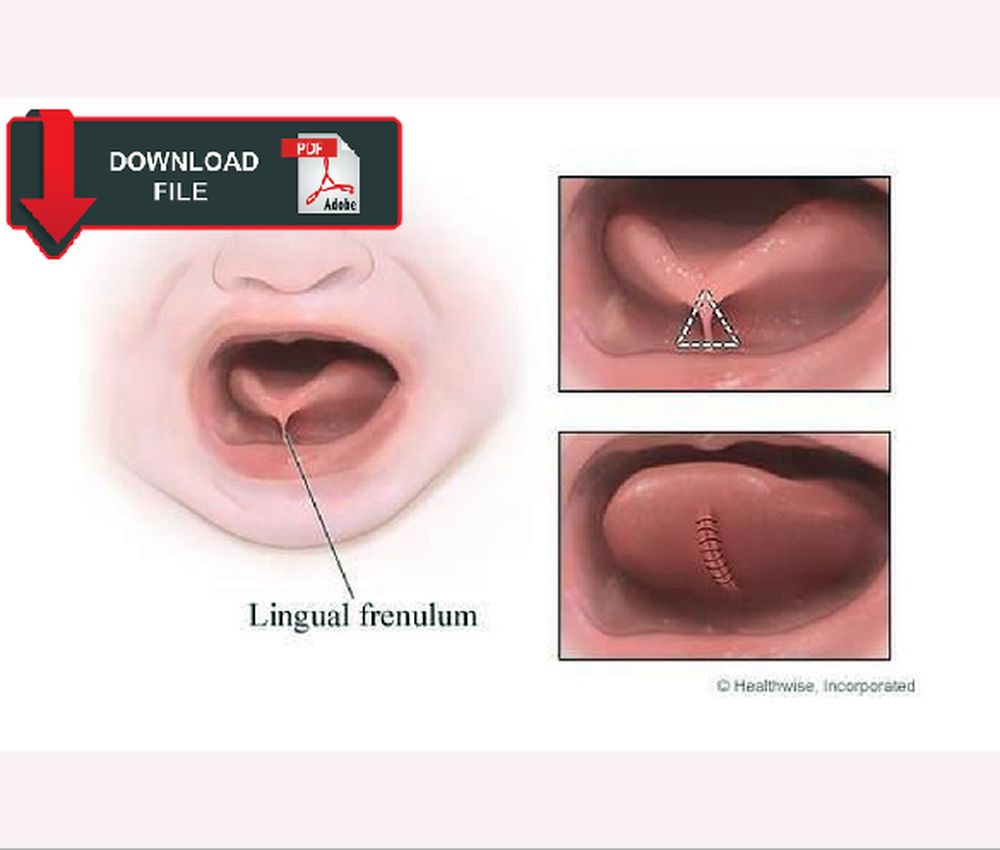
Pediatric frenectomy is a common surgical procedure performed to correct restrictive oral frenula that may interfere with breastfeeding, oral function, dental development, and speech.
📌 Recommended Article :
Dental Article 🔽 Clinical Indications for Frenectomy in Pediatric Dentistry: Evidence-Based Guidelines ... Frenectomy is a common surgical procedure in pediatric dentistry aimed at correcting abnormal frenum attachments that interfere with oral function, growth, and development.The relationship between frenulum abnormalities and speech disorders remains controversial, particularly in children. This article reviews current evidence regarding the indications for pediatric frenectomy, its potential impact on speech development, and clinical recommendations for patient selection.
Advertisement
Understanding the functional implications of ankyloglossia and aberrant labial frenula is essential for evidence-based treatment planning.
✅ Introduction
A frenulum is a fold of connective tissue that attaches soft tissues within the oral cavity. The most clinically relevant oral frenula in pediatric dentistry are the lingual and maxillary labial frenula. Abnormal attachment, thickness, or restriction may result in functional limitations, particularly in infants and children.
Pediatric frenectomy refers to the surgical removal or release of a restrictive frenulum. Although the procedure is frequently performed to improve tongue mobility and oral function, its role in speech development remains a subject of ongoing debate. Clinical decision-making should be based on functional impairment rather than anatomical appearance alone.
📌 Recommended Article :
Dental Article 🔽 When Is Antibiotic Prophylaxis Indicated in Pediatric Dentistry? ... Its primary objective is to prevent systemic infections caused by transient bacteremia during invasive dental procedures in children with underlying medical conditions.✅ Understanding Oral Frenulum Abnormalities
Ankyloglossia (Tongue-Tie)
Ankyloglossia is characterized by a short, thick, or restrictive lingual frenulum that limits tongue movement. The reported prevalence ranges from approximately 4% to 10% in pediatric populations.
Potential consequences include:
▪️ Breastfeeding difficulties
▪️ Impaired tongue mobility
▪️ Mechanical oral dysfunction
▪️ Challenges with oral hygiene
▪️ Orthodontic concerns
▪️ Potential speech articulation difficulties
Maxillary Labial Frenulum Abnormalities
An enlarged or low-attached maxillary labial frenulum may contribute to:
▪️ Persistent midline diastema
▪️ Gingival recession
▪️ Oral hygiene difficulties
▪️ Esthetic concerns
Unlike lingual frenula, labial frenula rarely affect speech production directly.
📌 Recommended Article :
Video/PDF 🔽 What is frenectomy? Step by step surgical procedure ... The frenectomy is performed under local anesthesia and has a short postoperative period without major complications. This surgical procedure can be performed on pediatric and adult patients.✅ Indications for Pediatric Frenectomy
Current evidence supports performing frenectomy when a restrictive frenulum produces measurable functional limitations.
Breastfeeding Dysfunction
In infants, frenectomy may be indicated when ankyloglossia contributes to:
▪️ Poor latch
▪️ Maternal nipple pain
▪️ Inefficient milk transfer
▪️ Inadequate weight gain
Several studies demonstrate improvement in breastfeeding outcomes following lingual frenotomy when significant restriction is present.
Speech Articulation Disorders
The relationship between tongue-tie and speech remains controversial.
A frenectomy may be considered when:
▪️ Restricted tongue mobility is documented
▪️ Speech articulation errors are directly attributable to tongue restriction
▪️ Evaluation by a speech-language pathologist supports intervention
▪️ Conservative therapy alone has been insufficient
Speech sounds potentially affected include:
▪️ /t/
▪️ /d/
▪️ /n/
▪️ /l/
▪️ /r/
▪️ /s/
▪️ /z/
▪️ /th/
However, many children with ankyloglossia develop normal speech despite anatomical restrictions.
Mechanical and Functional Limitations
Additional indications include:
▪️ Difficulty licking lips
▪️ Problems clearing food from teeth
▪️ Challenges with oral hygiene
▪️ ▪️ Tongue discomfort during movement
▪️ Functional restrictions affecting quality of life
Orthodontic and Periodontal Indications
Maxillary frenectomy may be indicated for:
▪️ Persistent midline diastema after eruption of permanent canines
▪️ Traumatic gingival tension
▪️ Gingival recession associated with frenulum pull
📌 Recommended Article :
Dental Article 🔽 Post-Anesthetic Soft Tissue Biting in Children: Prevention, Management, and Clinical Guidance ... Due to prolonged numbness of the lips, cheeks, or tongue, children—especially those under eight years of age—may unintentionally bite anesthetized tissues, resulting in traumatic ulcers, edema, and parental concern.✅ How Does Frenectomy Affect Speech Development?
Current Scientific Evidence
The impact of pediatric frenectomy on speech development remains an area of active investigation.
Recent systematic reviews indicate that:
▪️ Evidence supporting routine frenectomy solely for speech improvement is limited.
▪️ Many articulation disorders have multifactorial causes unrelated to tongue mobility.
▪️ Speech outcomes appear most favorable when a clear functional restriction is present.
▪️ Combined management involving surgery and speech therapy often yields superior results.
Several studies report improved articulation following frenectomy in selected patients. However, high-quality randomized controlled trials remain limited.
Why Speech Outcomes Vary
Speech production depends on multiple factors:
▪️ Neuromuscular development
▪️ Auditory processing
▪️ Cognitive development
▪️ Motor learning
▪️ Anatomical structures
▪️ Environmental influences
Consequently, correction of a restrictive frenulum alone may not resolve all speech difficulties.
Role of Speech Therapy
Speech-language evaluation is strongly recommended before considering surgical intervention for speech concerns.
Postoperative speech therapy may help patients:
▪️ Develop new tongue movement patterns
▪️ Improve articulation accuracy
▪️ Optimize functional outcomes
The combination of surgery and rehabilitation generally provides the most predictable results when speech impairment is present.
📌 Recommended Article :
Dental Article 🔽 Tongue-Tie in Babies: How a Short Lingual Frenulum Affects Breastfeeding and When Treatment Is Needed ... Although some babies with tongue-tie feed without difficulty, others experience poor latch, ineffective milk transfer, and early breastfeeding challenges, which may lead to frustration for both infants and parents.✅ Surgical Techniques
Several techniques may be used in pediatric frenectomy:
Conventional Scalpel Frenectomy
Advantages:
▪️ Widely available
▪️ Cost-effective
Limitations:
▪️ Greater intraoperative bleeding
▪️ Need for sutures in some cases
Laser Frenectomy
Common laser systems include:
▪️ Diode lasers
▪️ CO₂ lasers
▪️ Er lasers
Potential benefits:
▪️ Reduced bleeding
▪️ Improved visibility
▪️ Minimal postoperative discomfort
▪️ Faster healing
▪️ Reduced need for sutures
Electrosurgery
Electrosurgery may provide effective tissue management but requires careful thermal control to prevent collateral tissue damage.
📌 Recommended Article :
PDF 🔽 Oral Surgery: Use of laser in lingual frenectomy in pediatric patients ... We share an interesting clinical case of a 7-year-old girl referred by the orthodontist for a lingual frenectomy. In the article we can find the benefits of using laser in frenectomy.💬 Discussion
The decision to perform pediatric frenectomy should be based on functional assessment rather than anatomical appearance alone. Although ankyloglossia has been associated with breastfeeding difficulties and certain speech articulation problems, current evidence does not support universal surgical intervention.
For speech-related concerns, multidisciplinary evaluation involving pediatric dentists, orthodontists, otolaryngologists, lactation consultants, and speech-language pathologists is often necessary. Existing literature suggests that patients with documented tongue mobility restrictions and corresponding articulation deficits may experience improvement after surgery. However, not all speech disorders are attributable to frenulum abnormalities.
Furthermore, overtreatment remains a concern due to increasing public awareness and social media influence regarding tongue-tie management. Evidence-based diagnosis and careful patient selection are therefore essential.
🎯 Clinical Recommendations
For Pediatric Dentists
▪️ Perform comprehensive functional assessments.
▪️ Avoid recommending frenectomy based solely on anatomical appearance.
▪️ Document tongue mobility limitations objectively.
▪️ Consider validated assessment tools when available.
For Speech Concerns
▪️ Obtain evaluation from a speech-language pathologist.
▪️ Confirm that articulation difficulties are directly related to restricted tongue movement.
▪️ Consider postoperative speech therapy when indicated.
For Orthodontic Management
▪️ Delay maxillary labial frenectomy for diastema management until appropriate orthodontic timing has been established.
▪️ Evaluate eruption status of permanent canines before intervention.
For Parents
▪️ Seek professional evaluation when feeding, speech, or oral function concerns arise.
▪️ Understand that surgery may not be necessary in all cases.
▪️ Follow postoperative exercises and therapy recommendations when prescribed.
✍️ Conclusion
Pediatric frenectomy can be a valuable treatment for selected children with clinically significant frenulum restrictions affecting feeding, oral function, periodontal health, or speech articulation. However, current evidence indicates that frenectomy should not be performed solely on the basis of frenulum appearance. The relationship between ankyloglossia and speech disorders is complex and multifactorial. A comprehensive functional assessment and multidisciplinary approach remain essential to achieving optimal outcomes. When speech impairment is directly linked to restricted tongue mobility, frenectomy combined with speech therapy may provide meaningful clinical benefits.
📚 References
✔ American Academy of Pediatric Dentistry. (2024). Policy on management of the frenulum in pediatric dental patients. The Reference Manual of Pediatric Dentistry. Chicago, IL: American Academy of Pediatric Dentistry.
✔ Francis, D. O., Chinnadurai, S., Morad, A., Epstein, R. A., Kohanim, S., McPheeters, M., & Walsh, J. (2015). Treatments for ankyloglossia and ankyloglossia with concomitant lip-tie. JAMA Otolaryngology–Head & Neck Surgery, 141(7), 646–653. https://doi.org/10.1001/jamaoto.2015.0987
✔ Messner, A. H., & Lalakea, M. L. (2002). The effect of ankyloglossia on speech in children. Otolaryngology–Head and Neck Surgery, 127(6), 539–545. https://doi.org/10.1067/mhn.2002.129731
✔ O'Shea, J. E., Foster, J. P., O'Donnell, C. P. F., Breathnach, D., Jacobs, S. E., Todd, D. A., & Davis, P. G. (2017). Frenotomy for tongue-tie in newborn infants. Cochrane Database of Systematic Reviews, 3, CD011065. https://doi.org/10.1002/14651858.CD011065.pub2
✔ Webb, A. N., Hao, W., & Hong, P. (2013). The effect of tongue-tie division on breastfeeding and speech articulation: A systematic review. International Journal of Pediatric Otorhinolaryngology, 77(5), 635–646. https://doi.org/10.1016/j.ijporl.2013.03.008
✔ Yoon, A., Zaghi, S., Ha, S., Law, C. S., Guilleminault, C., & Liu, S. Y. C. (2017). Toward a functional definition of ankyloglossia: Validating current grading scales for tongue-tie by using objective measures. Journal of Oral Rehabilitation, 44(9), 709–721. https://doi.org/10.1111/joor.12536
📌 More Recommended Items
► Pediatric Dental Trauma Management: Key IADT 2024–2025 Guideline Updates
► Antibiotics in Pediatric Dentistry: When They Are Needed and When They Are Not
► Analgesic and Antibiotic Recommendations in Pediatric Oral Surgery